Amateur radio, also known as ham radio, is a non-commercial two-way radio service that allows people to communicate without the use of the internet or cell phones. Ham radio operators use frequency bands across the radio spectrum to set up and operate communication networks for governmental and emergency officials, as well as non-commercial communication for private citizens. Ham radio can be used to communicate across town, around the world, or even into space. It can be a lifeline during times of need.
My Story
When I was 13, I took the Novice Test (no longer required) and obtained the callsign KD6PJP. Shortly thereafter I upgraded to the much more useful Technician Class. It took a ‘few’ years to go by and I got bit by the upgrade bug and in 2016 I upgraded to General and then obtained the call of W6NIK. I had my fun at that level for a while but in 2022 I took on the challenge of the Amateur ‘Extra’ Class. Passing that in October of 2022, I waited around until a new callsign was available that I was happy with to ‘showoff’ my new Extra privilege’s. On Pi Day, 2023 (3/14/23) I obtained W6QY!
Technician Class License
The FCC Technician License exam covers basic regulations, operating practices and electronics theory, with a focus on VHF and UHF applications. Morse code is not required for this license. With a Technician Class license, you will have all ham radio privileges above 30 MHz. These privileges include the very popular 2-meter band. Many Technician licensees enjoy using small (2 meter) hand-held radios to stay in touch with other hams in their area. Technicians may operate FM voice, digital packet (computers), television, single-sideband voice and several other interesting modes. You can even make international radio contacts via satellites, using relatively simple station equipment. Technician licensees now also have additional privileges on certain HF frequencies. Technicians may also operate on the 80, 40 and 15 meter bands using CW, and on the 10 meter band using CW, voice and digital modes.
General Class License
The General Class license is the second of three US Amateur Radio licenses. To upgrade to General Class, you must already hold a Technician Class license (or have recently passed the Technician license exam). Upgrading to a General license–which conveys extensive HF privileges—only requires passing a written examination. Once you do, the entire range of operating modes and the majority of the amateur spectrum below 30 MHz become available to you.
Extra Class License
General or Advanced licensees may upgrade to Extra Class by passing a 50-question multiple-choice examination. No Morse code test is required. In addition to some of the more obscure regulations, the test covers specialized operating practices, advanced electronics theory and radio equipment design.
The HF bands can be awfully crowded, particularly at the top of the solar cycle. Once one earns HF privileges, one may quickly yearn for more room. The Extra Class license is the answer. Extra Class licensees are authorized to operate on all frequencies allocated to the Amateur Service.
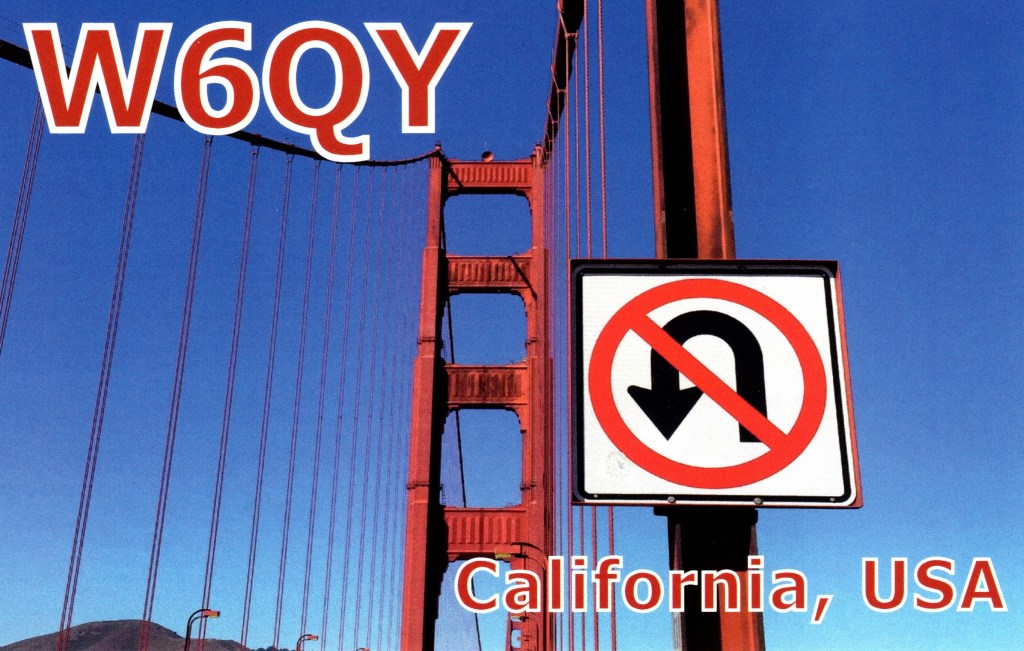
 W6QY
W6QY 